By Shubham Kumar | Radiance Haute
Walk into a Le Labo boutique and the first thing you notice is what is missing.
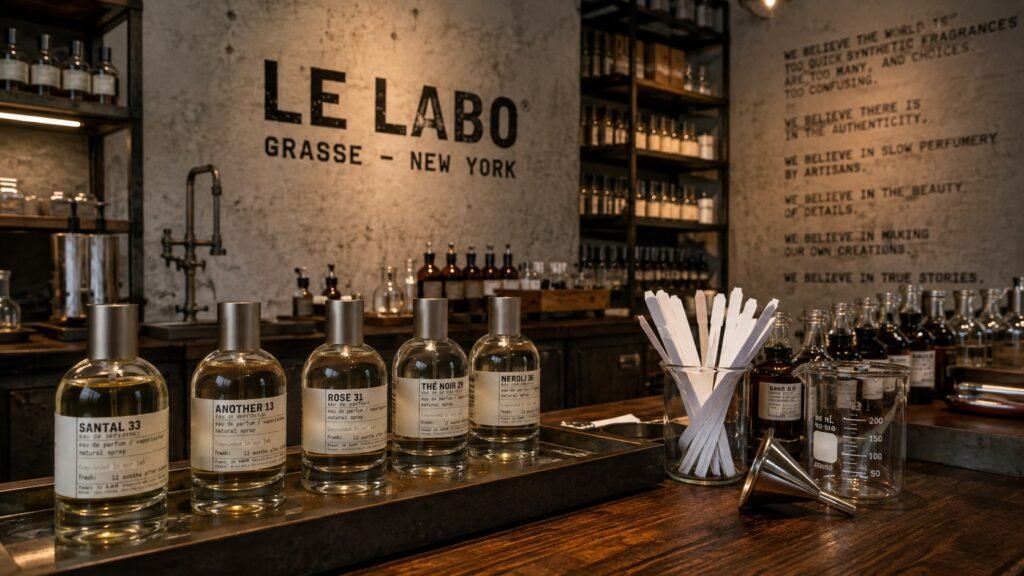
There are no oversized celebrity portraits, no dramatic campaign visuals and little of the traditional glamour that has long defined luxury fragrance. Instead, there are bottles lined up like objects in a laboratory, handwritten-looking labels, raw materials, aged surfaces and an atmosphere that feels deliberately imperfect. It is quieter than most luxury beauty spaces, but somehow that quietness makes it more memorable.
That is the paradox of Le Labo. The brand has built a global following while appearing almost uninterested in behaving like a traditional global fragrance house.
Founded in New York in 2006 by Fabrice Penot and Eddie Roschi, both former L’Oréal executives, Le Labo was created around a different idea of perfumery. The founders wanted to move away from the speed, commercial pressure and formulaic approach they had experienced within the larger fragrance industry and create something slower, more personal and more focused on the craft itself.
Almost twenty years later, that philosophy has become the foundation of one of contemporary fragrance’s most recognisable brands.
A Different Idea of Luxury
Le Labo’s appeal begins with its refusal to overstate itself.
The name, French for “the laboratory,” immediately establishes the world the brand wants to create. Its boutiques resemble workshops and apothecaries rather than conventional perfume stores. Natural materials, exposed textures and visible imperfections sit alongside precise displays and carefully arranged bottles. The aesthetic feels luxurious without looking conventionally luxurious.
That tension is important.
Luxury has traditionally relied on polished surfaces, elaborate packaging and visible symbols of status. Le Labo takes a more contemporary approach, where craftsmanship and authenticity become the signals of value. Its imperfections are not flaws that need to be hidden; they are part of the visual language.
The result is a brand that feels considered rather than manufactured.
That distinction matters at a time when consumers are increasingly surrounded by highly produced advertising and endless product launches. Le Labo does not need to repeatedly tell its audience that it is artisanal. The experience is designed to communicate that idea before the brand ever has to explain it.
When the Bottle Becomes Personal
The experience becomes even more distinctive at the point of purchase.
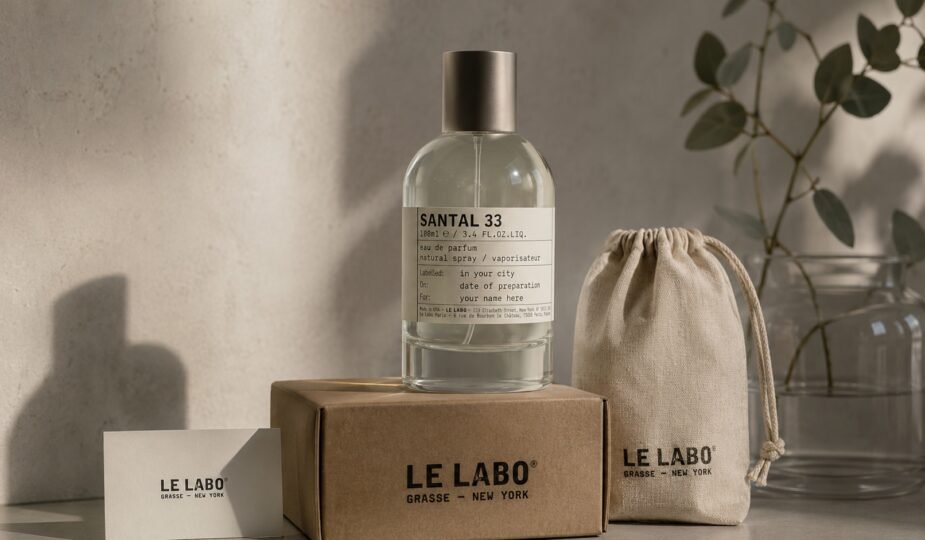
Le Labo is known for personalising its fragrance labels, allowing the customer’s name or a personal message to become part of the bottle. The fragrance is not presented simply as another finished product taken from a shelf. The buying process becomes part of the story.
This small detail has a surprisingly powerful effect.
A luxury fragrance can already feel personal because scent is closely connected to memory and identity. Le Labo extends that intimacy into the physical object itself. The bottle becomes something that belongs specifically to the person who bought it.
It is a subtle example of how luxury can be created through experience rather than material extravagance.
The value of the product is no longer determined only by the fragrance inside the bottle. It also comes from the ritual surrounding it: discovering the scent, trying it on skin, choosing a favourite, personalising the bottle and eventually associating it with a particular moment in life.
Le Labo has understood that the journey to ownership can be just as important as the object itself.
The Making of Santal 33
Among Le Labo’s fragrances, Santal 33 remains the clearest example of what happens when a perfume becomes a cultural symbol.
Built around sandalwood, cedarwood, cardamom, iris, violet and smoky, leathery and musky facets, Santal 33 has a distinctly woody character. But its success cannot be explained by its ingredients alone.
Over time, the fragrance became associated with a particular image of contemporary urban life. New York, creative culture, fashion, design, boutique hotels and minimalist interiors all became part of the world surrounding the scent.
That is when fragrance moves beyond the formula.
Santal 33 became recognisable not only because of how it smelled, but because of what wearing it seemed to communicate. It became part of a visual and cultural vocabulary.
This is one of the hardest achievements in luxury branding. A company can spend millions trying to manufacture an association between a product and a lifestyle, but when consumers begin creating those associations themselves, the brand enters a different territory.
Le Labo did not simply create a successful fragrance.It created a symbol.
The Numbers Behind the Names
Even the way Le Labo names its fragrances contributes to this sense of distinction.
SANTAL 33. ANOTHER 13. ROSE 31. THÉ NOIR 29. THÉ MATCHA 26.
The names are immediately recognisable, but they also feel different from the romantic naming conventions traditionally used in fragrance. There is something almost scientific about them, reinforcing the laboratory concept without having to explain it.
The system also gives the collection a sense of coherence. Each fragrance belongs to the same world, while retaining its own identity.
This is a small but effective example of brand architecture. The individual products are important, but they are also recognisable as part of something larger.Le Labo has managed to make its naming system part of its visual identity.
The Power of Slowness
The idea of slowness sits at the centre of the Le Labo philosophy.
The modern beauty industry is built around speed. Trends emerge, products launch, consumers move on and brands respond with something new. Fragrance has increasingly become part of this cycle, with houses introducing new interpretations, limited editions and collaborations to maintain attention.
Le Labo has taken a different route.
Its approach places greater emphasis on developing fragrances carefully and maintaining a relatively focused collection. The brand has positioned time itself as part of the value proposition.That is particularly interesting in luxury because time is one of the few things that cannot easily be manufactured at scale.
A product that takes years to develop communicates something different from one created to meet the next seasonal trend. It suggests patience, conviction and a willingness to wait for the right result.
In this sense, “slow perfumery” is not simply a production philosophy. It becomes a marketing asset.
A Brand That Does Not Need to Shout
Perhaps the most fascinating aspect of Le Labo’s strategy is its relationship with traditional advertising.
Luxury fragrance has historically been one of the industry’s most image-driven categories. Major houses invest heavily in celebrity ambassadors, cinematic campaigns and carefully constructed worlds designed to make a fragrance desirable.
Le Labo has largely built its reputation through a quieter form of visibility.The brand can be discovered through its boutiques, through friends, through social conversations, through luxury hotels and through carefully selected partnerships. The consumer encounters the product in an environment where the brand already makes sense.
That difference is significant.
Seeing a fragrance in an advertisement tells you that the brand wants your attention. Discovering it unexpectedly in a luxury hotel or experiencing its products as part of a premium wellness environment creates a different emotional response.
The consumer discovers the brand rather than being introduced to it.And discovery creates curiosity.Curiosity creates conversation.Conversation creates word of mouth.For a luxury brand, that can be far more valuable than simply generating impressions.
Putting the Brand in the Right Places
Le Labo’s partnerships with premium hospitality and wellness businesses demonstrate how carefully the brand approaches distribution and discovery.
A luxury hotel guest encountering Le Labo products in a bathroom is not experiencing the brand in the same way as someone seeing an advertisement while scrolling through a social platform. The fragrance is being experienced within an environment already associated with comfort, travel and elevated service.
The same principle applies to premium wellness spaces.The brand becomes part of a ritual that the consumer has already chosen to invest in.
This is why selective partnerships can be more powerful than simply pursuing maximum distribution. The question is not only where the product can be sold, but where the product makes sense.
For Le Labo, the answer is often environments where consumers are already thinking about personal care, design, travel and lifestyle.The placement feels natural because the brand is not interrupting the experience.It is becoming part of it.
The Estée Lauder Paradox
There is an intriguing contradiction at the heart of Le Labo’s story.
The company was founded by two former corporate executives who wanted to build something more independent and less constrained by large-scale commercial thinking. Yet in 2014, Le Labo was acquired by The Estée Lauder Companies.
At first, the decision seems almost contradictory.Why would a brand built around independence become part of one of the world’s largest beauty groups?The answer lies in the difference between brand creation and brand scaling.Le Labo had already developed something difficult to manufacture: cultural credibility. What it needed to expand globally was infrastructure.
A major beauty group can provide capital, international distribution, supply-chain capabilities and access to markets that would be difficult for a relatively small fragrance house to build independently.
But the danger is obvious. Scale can make a niche brand feel less niche.
The challenge therefore becomes not whether the brand can grow, but whether it can grow without losing the characteristics that made people want it in the first place.That is the real test of luxury management.Growth should increase the reach of the brand without reducing its desirability.
A New Fragrance Culture
Le Labo’s rise has also coincided with a broader transformation in the fragrance market.
Consumers are increasingly moving away from the idea that everyone should have one signature fragrance. Instead, many are building fragrance wardrobes, choosing different scents depending on their mood, season, outfit or occasion.
This shift has changed the role of perfume.
Fragrance is becoming less about simply smelling good and more about expressing identity.
A consumer might want something woody one day, floral the next and darker or more intimate in the evening. Different fragrances can represent different versions of the same person.
For niche brands, this creates an interesting opportunity.The consumer is no longer looking for one answer.They are looking for discovery.
Le Labo’s portfolio fits naturally into this behaviour because each fragrance has a distinct personality while remaining connected to the same brand universe.
Beyond the Bottle
What makes Le Labo fascinating is not that it has discovered a secret formula for making perfume expensive. Luxury fragrance has always depended on exceptional ingredients, skilled perfumers and meticulous craftsmanship. Le Labo’s achievement lies elsewhere: in creating a brand where almost every touchpoint communicates the same philosophy.
The understated labels, imperfect boutiques, distinctive names, personalised bottles, selective partnerships and carefully controlled product portfolio all tell the same story. Nothing feels excessively loud, yet nothing feels accidental either.
In an industry increasingly defined by constant launches and relentless visibility, that restraint has become one of Le Labo’s strongest forms of differentiation.
The brand does not appear to be trying too hard to convince consumers that it is luxurious.It simply behaves as though it already knows.
And perhaps that is the most contemporary form of luxury.Not excess, but confidence.Not constant visibility, but meaningful discovery.Not telling consumers what to desire, but creating something they want to discover for themselves.
Le Labo’s real achievement, then, is larger than perfume. It has built an ecosystem in which product, place, packaging, personalisation and culture reinforce one another. The fragrance may be what the customer takes home, but the experience is what makes the bottle worth remembering.
In a market crowded with brands competing for attention, Le Labo offers a quieter lesson.
Luxury does not always need to speak louder. Sometimes, it simply needs to give people a reason to come closer.
By Shubham Kumar
Radiance Haute