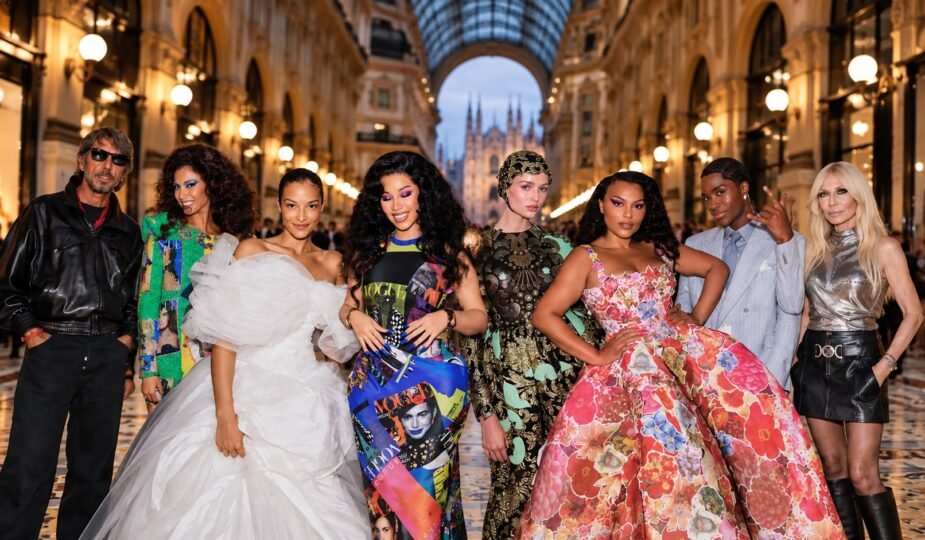
On September 22, Milan’s Galleria Vittorio Emanuele II became the stage for the fifth edition of Vogue World, opening Milan Fashion Week Spring/Summer 2027 with a production that placed Italian craftsmanship, fashion, performance and technology in the same frame.
Titled “The Human Touch in the Age of Technology,” Vogue World: Milano 2026 was built around a question increasingly relevant to luxury: as technology and artificial intelligence reshape how products are designed, produced and experienced, what happens to the human knowledge that has traditionally defined craftsmanship?
Vogue’s answer was not to position technology against craft, but to place them within the same continuum. The evening moved from Renaissance artisanship and industrial production to Made in Italy, intelligent textiles and an imagined future, turning Milan itself into part of the narrative.
Milan as the Setting
The choice of venue was as important as the clothes.
Rather than constructing a temporary runway, Vogue transformed the Galleria Vittorio Emanuele II, Milan’s 19th-century glass-roofed arcade between the Duomo and Teatro alla Scala, into a fashion stage.
It was a fitting setting for a show concerned with the relationship between heritage and modernity. The Galleria has always represented more than architecture: it is a meeting point for culture, commerce and luxury. Bringing Vogue World into the space allowed those ideas to become part of the production itself.
The event was held under the patronage of the Municipality of Milan and Camera Nazionale della Moda Italiana, with contributions from Teatro alla Scala and Accademia Teatro alla Scala.
Milan was therefore not simply the location. It was one of the show’s characters.
From Hand to Machine
The creative structure followed five acts: The Artisanal Revolution, The Industrial Revolution, Made in Italy, The Age of Intelligence and The Imagination Revolution.
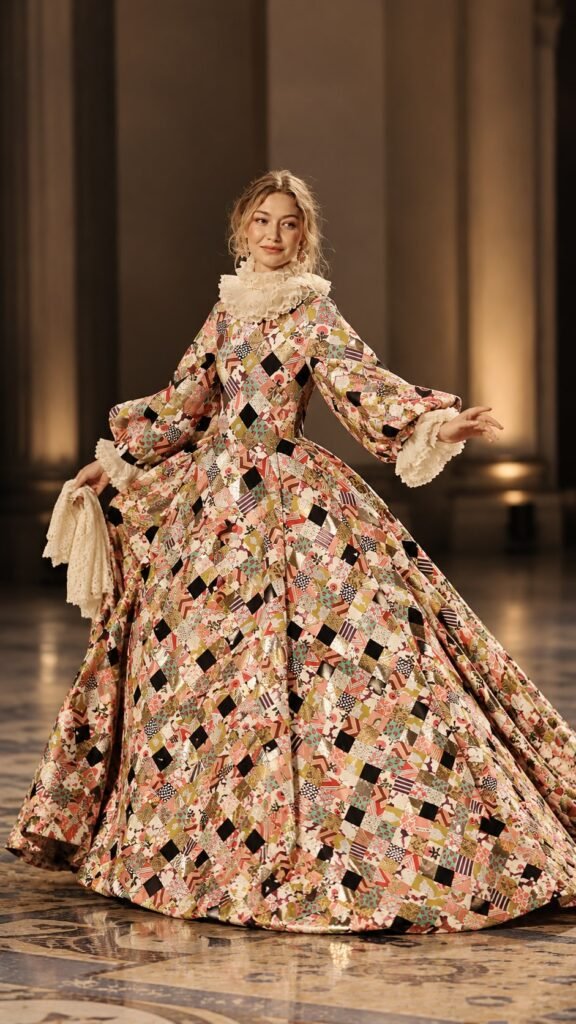
The opening looked back to the Renaissance, when artists, artisans and inventors worked across disciplines. Brocades, lace, ornament and hand-worked surfaces established craftsmanship as the foundation of Italian creative culture.
The narrative then moved into industrialisation, with Turin representing Italy’s manufacturing and automotive heritage. Tailoring, wool, structured silhouettes and industrial materials replaced the decorative language of the opening.
From there came the world most associated with Italian fashion: Made in Italy.
Colour, cinema and glamour entered the story, with references to Federico Fellini and La Dolce Vita. The Italian diva became a cultural symbol, connecting fashion to cinema, celebrity and the construction of modern Italian glamour.
The progression was deliberate. Vogue was not presenting craftsmanship as an artefact of the past. It was showing how it evolved alongside technology and industry.
The Italian Fashion Houses
Prada, Giorgio Armani, Versace, Ferragamo and Gucci were among the Italian houses involved in creating special pieces for Vogue World.
The distinction is important. These were not simply looks taken from existing collections and placed into a different setting. The houses were contributing to a larger cultural narrative created specifically for the event.
The show also brought together models from different generations, including Gigi Hadid, Mariacarla Boscono, Vittoria Ceretti, Alex Consani, Amelia Gray, Helena Christensen, Irina Shayk, Ashley Graham and Anok Yai.
That casting reinforced one of the show’s quieter ideas: fashion knowledge is transmitted between generations. A house code survives not because it remains unchanged, but because each generation finds a way to reinterpret it.
The Age of Intelligence
The fourth act brought the central question of the evening into the present.
Vogue explored the relationship between fashion and intelligent technology through the idea of textiles capable of responding to temperature, movement, performance and environmental conditions.
This was perhaps the most significant conceptual shift in the show.
Technology was not presented as the opposite of craftsmanship. Instead, it became another instrument of human creativity.
That distinction is increasingly important for luxury. As artificial intelligence, digital design and advanced manufacturing become part of the creative process, the value of human expertise may become more visible rather than less.
The future of craftsmanship may therefore not be about protecting the handmade from technology. It may be about deciding where technology can extend human capability without erasing the knowledge behind the object.
Fashion as Performance
Vogue World has always operated beyond the traditional fashion-show format, but Milan pushed that idea further.
Italian ballet star Roberto Bolle performed with his company inside the Galleria, accompanied by music from La Traviata reimagined by choreographer Laccio. The dancers wore bespoke Ferrari looks created by creative director Rocco Iannone.
The Teatro alla Scala chorus also became part of the production. Benetton dressed 103 young choristers between nine and 20, while opera performers appeared from the Galleria’s windows.
The result was closer to a fashion opera than a conventional runway.
Fashion, music, architecture and movement became different forms of the same storytelling language.
The Celebrity Effect
The casting extended well beyond professional models.
Jennifer Lopez, Cardi B, Alicia Keys, J Balvin, MGK, Simone Ashley, Madelyn Cline, Madelaine Petsch, Iris Law, Laura Harrier, Aryna Sabalenka, Jeremy Pope, Sam Claflin, Ghali, Ejae and Matteo Bocelli were among the celebrities participating.
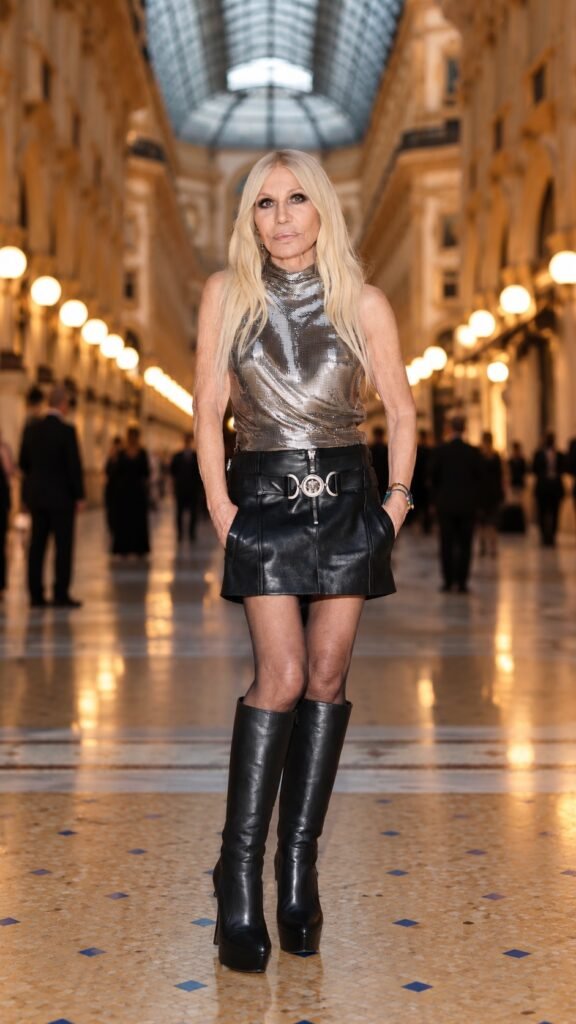
Cardi B appeared in Versace, Jennifer Lopez in Dolce & Gabbana, Aryna Sabalenka in Gucci and Sam Claflin in Armani.
The celebrity presence is central to the Vogue World formula. A conventional fashion show primarily addresses buyers, editors and industry insiders. Vogue World is designed to reach a much broader cultural audience.
Fashion becomes entertainment, entertainment becomes media content, and media content extends the life of the event far beyond the physical runway.
Alicia Keys and the Human Element
One of the evening’s major musical moments came from Alicia Keys, who wore a custom hand-painted look from Francesco Risso’s Bureau of Imagination.
She closed the show with I Feel Love, surrounded by models in ethereal white looks.
Her performance returned the event to its central idea. In an increasingly digital fashion ecosystem, live performance remains fundamentally human: a physical voice, a physical body and an audience sharing the same space.
The contrast was intentional.Technology may expand the possibilities of fashion, but the emotional experience still depends on people.
Beauty as a Historical Language
Beauty followed the same historical progression as the clothes.
Pat McGrath led makeup, Cyndia Harvey handled hair and Eri Narita directed nails.
The references moved between Renaissance-inspired blush, Botticelli-influenced braids, geometric eye makeup, neon nails and Italian manicure techniques.
Rather than treating beauty as a supporting detail, Vogue used it as another layer of cultural storytelling.
The message was consistent across the show: Italian heritage can be referenced without being reproduced literally.
Heritage, Vintage and Circular Fashion
The relationship with heritage also appeared through the use of vintage and pre-owned fashion.
Selected pieces and accessories were sourced through eBay, Vogue’s official vintage and pre-loved partner for the event.
It was a fitting addition to a show built around memory and continuity.
Vintage fashion transforms the past into an active resource. An old garment can become a new cultural reference without requiring the same level of material production as an entirely new object.
In this context, circularity becomes another form of heritage preservation.
When Technology Enters the Show
Technology was not hidden behind the production.
Drones captured the spectacle for digital audiences, while robots appeared toward the end of the event as the narrative moved toward its imagined future.
The progression was almost cinematic:
Hand → Machine → Made in Italy → Intelligence → Imagination.
The finale pushed the idea further. Paper objects designed by the LoveFrom team were folded by hand from single pieces of paper, drawing inspiration from dragonflies, Milanese lace, Venetian mosaics and the architecture of the Galleria.
Technology was then used to simulate the Galleria and visualise how thousands of the objects could move through the space.
The symbolism was difficult to miss: human hands made the objects while technology helped imagine their movement.
The Business Behind the Spectacle
Perhaps the most revealing aspect of Vogue World is not what happens on the runway, but what happens around it.
Vogue World has developed into a sophisticated commercial platform combining editorial authority, fashion, entertainment, sponsorship, celebrity, hospitality and digital distribution.
Condé Nast’s major-events business, which includes Vogue World alongside properties such as the Met Gala and Vanity Fair Oscar Party, has become an increasingly important part of the company’s broader commercial strategy. Business of Fashion has reported significant growth in this category and described Vogue World as an increasingly ambitious business proposition.
The Milan edition featured presenting sponsors including ALO, eBay, Eli Lilly and Company and Meta Glasses, with additional support from FedEx and OpenAI, alongside a wider network of Italian brands and cultural institutions.
The model is relatively simple in principle but powerful in execution:
Editorial influence + cultural relevance + celebrity + live experience + sponsorship + digital distribution.
Vogue is no longer simply publishing fashion. It is creating an environment in which fashion can become an experience and then be distributed as media.
Beyond the Galleria
The event also carried a local cultural commitment.
Vogue pledged at least €2 million toward the redevelopment of the Quarto Oggiaro Library in northwestern Milan. The planned centre aims to support fashion, music, artistic talent, creativity, technology and community.
That commitment gives Vogue World a legacy beyond the spectacle.
It also connects directly with the show’s central idea. Creativity is not only about objects or images; it depends on places where people can learn, experiment and create.
Why Vogue World Matters
Vogue World represents a broader transformation in fashion media.
The traditional fashion magazine operated primarily through editorial pages, photography and criticism. Vogue World expands that authority into physical space.
A single production can bring together fashion houses, performers, musicians, athletes, technology companies, cultural institutions, sponsors and a global digital audience.
That makes Vogue World less like a conventional fashion show and more like a media franchise built around fashion culture.
Each city provides a new editorial framework. New York introduced the concept in 2022, followed by London in 2023, Paris in 2024 and Hollywood in 2025. Milan became the fifth destination, with Italian craftsmanship and technology defining its chapter.
The next edition will move to San Francisco in 2027, bringing Vogue World into another city strongly associated with technology and innovation.
The Takeaway
Vogue World: Milano 2026 ultimately offered a more nuanced argument about the future of fashion than the familiar debate between handmade craft and artificial intelligence.
Its message was that heritage does not have to remain static.
Italian craftsmanship can move from the Renaissance workshop to industrial production, from the fashion house to intelligent textiles and eventually into technologies that have yet to be fully defined.
The human touch remains the connecting thread.
For Vogue, however, the event represents something larger. Vogue World has evoled into a new kind of fashion-media platform: one where editorial authority becomes experience, experience becomes content, and content becomes a commercial ecosystem.
In Milan, that ecosystem found an appropriate setting — a historic marketplace transformed into a runway for the future.
Credit line:image via Vogue / photographer — used for commentary and critique.




[…] Vogue World Milano 2026: Where Italian Craft Meets the Age of Technology […]