From the grasslands of Mongolia to the world of Italian luxury, the story of cashmere is about more than softness. It is a combination of nature, craftsmanship and the people behind the material.
Celebrating the People Behind Cashmere
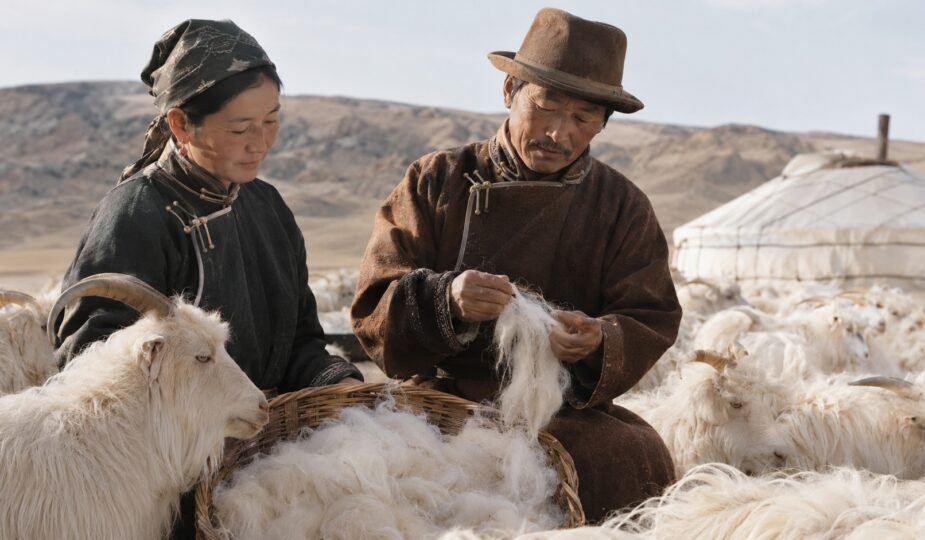
In New York, Italian luxury house Loro Piana celebrated the 11th edition of its Cashmere of the Year Award at the Brant Foundation. The event recognised three couples of herders from Inner Mongolia for producing exceptionally fine cashmere fibres.
The first prize went to Siqingbilige and Hasiqiqige, whose cashmere achieved an average fibre diameter of just 12.89 microns. The other two winning couples were Jiyatu and Gegentuya, with 13.01 microns, and Lifuqiang and Qiqi, with 13.04 microns.
For the occasion, Loro Piana also presented an exhibition titled Master of Cashmere: The Quest for Fibre Excellence. It offered visitors an opportunity to understand the journey of cashmere, from its origins and collection to the finished creations of the Maison.
Since its establishment in 2015, the award has recognised the contribution of herders to the production of exceptional cashmere. It also reflects something often overlooked in the luxury industry: behind every exceptional material, there are people whose knowledge and experience make its quality possible.
What Makes Cashmere Special?
Cashmere is a natural animal fibre obtained from the soft undercoat of cashmere goats. These goats are mainly raised in Mongolia, Inner Mongolia, China and other parts of Central Asia, where extreme seasonal temperatures have shaped the development of their thick winter coats.
A goat has two layers of hair. The outer layer consists of coarse guard hairs that protect it from environmental conditions, while the inner layer is made up of fine, soft fibres that provide insulation against the cold. It is this inner layer that becomes cashmere.
The fibre is generally collected between March and May, when goats naturally begin shedding their winter undercoat. Herders carefully comb the animals to collect the fine fibres without damaging the valuable material.
One reason cashmere is so appreciated in luxury fashion is its combination of softness, warmth and lightness. It provides insulation without the weight of many conventional wool fabrics.
However, producing cashmere is not a simple process. Only a relatively small proportion of a goat’s fleece consists of the fine undercoat suitable for cashmere production. The fibres must then be separated, cleaned and processed before they can be transformed into yarn.
This limited supply, combined with the specialised production process, contributes to its high value.
From Raw Fibre to Luxury Garment
The journey of cashmere involves several stages, and each one influences the quality of the final material.
It begins with the herders, who collect the undercoat during the seasonal shedding period. The raw fibres are then sorted according to their colour, length, fineness and overall condition.
After sorting, the material goes through washing and dehairing. Dehairing is particularly important because it separates the soft undercoat from the coarser guard hairs. The cleaned fibres are then spun into yarn, which can be knitted or woven into finished textiles.
Finally, the fabric undergoes finishing processes to achieve the desired texture, softness and appearance.
What makes this process interesting is that the quality of a finished cashmere garment is influenced long before it reaches the hands of a designer. The original fibre, its preparation and the technical knowledge involved in processing it all contribute to the final result.
Understanding Cashmere Quality: Why Microns Matter
When discussing premium cashmere, one measurement frequently appears: microns.
A micron is one-millionth of a metre and is used to measure the diameter of an individual fibre. Generally, finer fibres feel softer against the skin, which is why fibre fineness is an important consideration in cashmere production.
For example, the winning cashmere at Loro Piana’s latest award measured just 12.89 microns in diameter. This is exceptionally fine, even by luxury textile standards.
However, fineness alone does not determine the quality of cashmere. Fibre length, strength, consistency and colour are also important.
Longer fibres can help produce stronger yarns and reduce the likelihood of pilling. Fibre uniformity contributes to a more consistent textile, while natural colour influences the possibilities for dyeing and finishing.
This explains why two garments labelled 100% cashmere can have very different qualities. The percentage tells us the composition of the material, but not necessarily the quality of the original fibre or the craftsmanship involved in making the garment.
Why Cashmere Is Important to Loro Piana
For Loro Piana, cashmere is closely connected to the identity of the Maison. The Italian luxury house has spent decades developing its expertise in sourcing, selecting and processing some of the world’s finest natural fibres.
Its relationship with Mongolian cashmere producers extends back more than 40 years. The company also operates a manufacturing facility in Ulaanbaatar, Mongolia, where the initial processing of cashmere takes place.
In 2009, Loro Piana introduced the Loro Piana Method, an initiative focused on improving cashmere quality and supporting the preservation of the Alashan goat.
More recently, in 2025, the Maison introduced Resilient Threads, a five-year programme developed in partnership with the United Nations Convention to Combat Desertification. The initiative focuses on supporting herding communities, strengthening local livelihoods and protecting biodiversity in Mongolia.
These efforts highlight an important part of luxury manufacturing. Maintaining the quality of a material requires more than advanced machinery or skilled designers. It also depends on the people, animals and environments involved in its production.
The Environmental Challenge of Cashmere
Despite its reputation as a premium natural material, cashmere production also faces environmental challenges.
The growing global demand for cashmere has contributed to the expansion of goat herds in parts of Mongolia. While herding provides an important source of income for local communities, excessive grazing can put pressure on fragile grassland ecosystems.
Goats can consume vegetation close to the ground. When grazing exceeds the land’s ability to recover, it can contribute to vegetation loss, soil degradation and desertification.
This creates an important question for luxury brands: how can they continue producing exceptional natural fibres while protecting the environments and communities responsible for them?
The answer requires responsible grazing practices, animal welfare, better traceability and long-term investment in local communities.
For brands such as Loro Piana, this is becoming an increasingly important part of the conversation around responsible luxury. Producing a high-quality material should also involve understanding its environmental and social impact.
Cashmere Compared With Other Luxury Fibres
Cashmere is not the only natural fibre valued by the luxury fashion industry. Materials such as merino wool, alpaca and silk each have their own characteristics and applications.
Cashmere is particularly appreciated for its softness and warmth with relatively little weight. Merino wool is known for its elasticity and temperature regulation, while alpaca offers warmth, softness and durability. Silk, meanwhile, is valued for its smooth texture and natural lustre.
The choice of material depends on the purpose of the garment, its design and the characteristics a fashion house wants to achieve.
For luxury brands, materials are not simply production choices. They are an important part of product identity and brand positioning.
The Future of Cashmere in Luxury Fashion
The story of cashmere goes beyond the finished sweater, scarf or coat. It connects natural resources, traditional knowledge, textile technology and the people involved in production.
As consumers become more interested in craftsmanship, material quality and responsible sourcing, luxury houses will need to pay greater attention to where their materials come from and how they are produced.
Loro Piana’s Cashmere of the Year Award is an interesting example of how a luxury house can bring attention to the people behind a material that is often appreciated only after it becomes a finished product.
For me, this is what makes the story particularly interesting. We often associate luxury with the final design, the brand name or the price of a product. But the real story can begin much earlier, with a fibre collected by a herder in the grasslands of Mongolia.
Luxury is not only about what we see in the finished product. It is also about the knowledge, people and craftsmanship that make it possible.