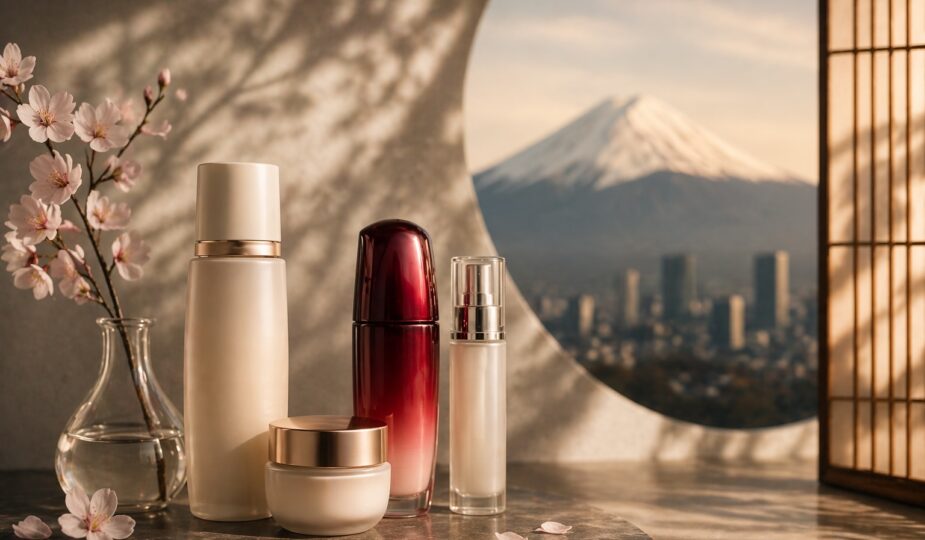
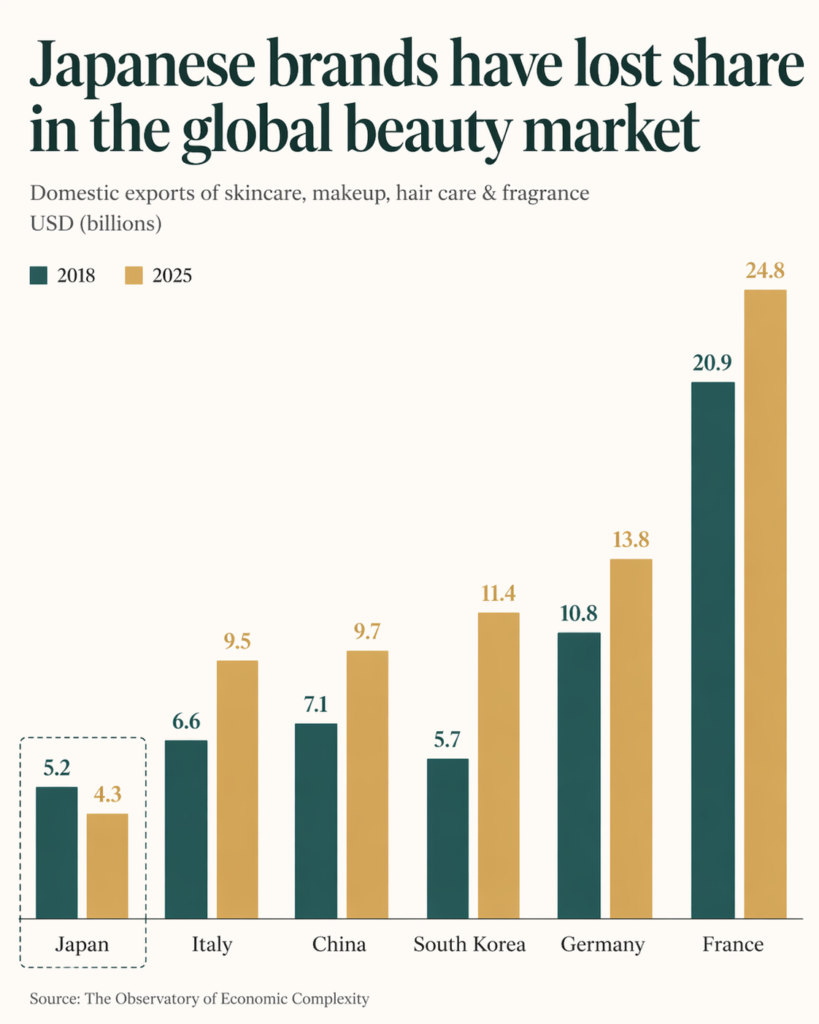
For decades, Japan represented one of the most advanced beauty cultures in the world. Rooted in precision, ritual, and scientific innovation, J-beauty set early standards for skincare that prioritized long-term results over instant transformation. Yet in today’s global market, influence is no longer defined by formulation alone. It is driven by visibility, storytelling, and cultural momentum. Recent industry data reflects a clear shift: while global beauty exports are growing, Japan’s presence is quietly contracting. The question is not whether J-beauty still delivers excellence, but why that excellence is no longer translating into global influence.
Precision Without Presence
At the core of J-beauty lies a philosophy of restraint. Brands such as Shiseido and KOSÉ Corporation have built their reputations on meticulous research, refined textures, and a preventive approach to skincare. The focus is not on dramatic before-and-after results, but on consistency over time.
However, this same philosophy has limited global reach. Instead of scaling distinctly Japanese identities, companies often leaned on internationally adaptable brands like NARS Cosmetics. These brands succeeded globally, but they did so by aligning with Western aesthetics rather than expressing a clear Japanese beauty narrative.
The result is a disconnect. Japan continues to produce exceptional products, yet lacks a strong, unified presence in the global beauty conversation.
France and the Power of Aspiration
In contrast, France has built an ecosystem where beauty is inseparable from aspiration. Backed by conglomerates like L’Oréal and LVMH, French beauty operates at the intersection of fashion, heritage, and storytelling.
Brands such as Dior Beauty and Chanel Beauty extend the mythology of couture into everyday products. A fragrance becomes an identity marker. A lipstick becomes a symbol of belonging to a larger cultural universe.
France does not compete on formulation alone. It competes on emotion. This ability to construct and export desire has positioned French beauty as the global benchmark.
South Korea and the Velocity of Trends
If France defines timeless luxury, South Korea defines speed. The rapid rise of Korean beauty reflects a system designed for constant innovation and digital amplification.
K-beauty brands excel at turning skincare into cultural content. Trends such as glass skin or multi-step routines are not just product categories; they are narratives designed for visibility and participation. Social media platforms have amplified this approach, allowing Korean brands to scale globally with remarkable speed.
In comparison, J-beauty’s understated approach feels almost invisible. Its emphasis on subtle improvement does not easily translate into the visual, high-impact storytelling that drives modern consumer attention.
A Shift in the Rules of Beauty
The global beauty market has evolved into what can be described as a narrative-driven economy. Success is no longer determined solely by product performance, but by the ability to create cultural relevance.
- France leads through heritage and aspiration
- South Korea dominates through trend creation and digital culture
- China is emerging through scale and speed
- Japan, despite its expertise, remains understated
This shift has exposed a critical gap. J-beauty has not failed in innovation, but in communication. Its values, while deeply considered, are not being translated into a format that resonates globally.
Reframing the Future of J-Beauty
Japan’s position today is not irreversible. In many ways, its philosophy aligns with emerging consumer priorities such as sustainability, longevity, and mindful consumption. The emphasis on prevention rather than correction speaks directly to a growing desire for authenticity and long-term value.
What is required is not reinvention, but reinterpretation. Japanese brands must learn to articulate their strengths through stronger storytelling, clearer identity, and more visible platforms. The challenge is to maintain their integrity while adapting to a faster, more expressive global market.









[…] a result, innovation strategies are increasingly focused on supporting artisans, preserving expertise, improving product […]